Last Updated: 04/02/2026
Abstract
Consumers often rely on "panel thickness" as the primary indicator of strength when purchasing garden sheds. However, from a structural engineering standpoint, a shed is a typical lightweight enclosure structure, and its stability is determined by a combination of "frame load-bearing capacity, panel enclosure, and connection system." This paper provides a comprehensive analysis of the engineering logic behind the application of thin steel panels, the impact of ribbed structures on rigidity, the reasonable tolerances for deformation, as well as the differences between metal, resin, and wood materials in terms of weather resistance, maintenance costs, and service life. Ultimately, the paper establishes a material selection model based on usage scenarios.
Keywords
Garden Shed
Structural Engineering
Thin Steel Panel
Corrugated Sheet
Material Comparison
Outdoor Storage
Shed Design
Structural Engineering
Thin Steel Panel
Corrugated Sheet
Material Comparison
Outdoor Storage
Shed Design
1. Introduction
In actual purchasing behavior, consumers often fall into the following misconceptions:
- Directly equating "thickness" with "strength"
- Misjudging "appearance deformation" as "structural failure"
- Simplifying "material differences" to "aesthetic choices"
These perceptions overlook a critical fact:
A garden shed is a “lightweight structural system,” not a “solid load-bearing component.”

3. Why Thin Steel Panels are Commonly Used in Metal Sheds
3.1 Lightweight Structural Design Principles
Sheds are classified as: Lightweight Structures
The design goal is not "maximum strength," but rather:
- Sufficient stability
- Easy transport
- Ease of installation
- Cost control
3.2 Why Not Use Thick Plates?
If thick steel plates were used:
- Weight would increase significantly (higher transportation costs)
- Installation difficulty would rise
- Costs would increase without a corresponding structural benefit
This is because:
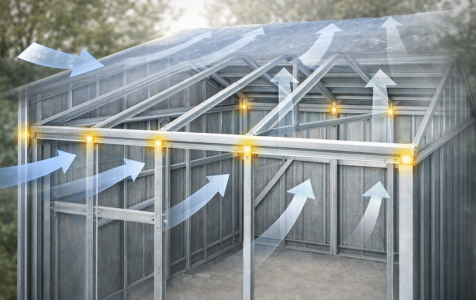
The structural strength bottleneck lies not in the panels, but in the frame and joints.
3.3 Engineering Optimization Concept
The essence of thin plate design is:
- Replacing material accumulation with structural design
- Enhancing performance through shape
4. Why Thin Plates Still Exhibit High Stiffness
4.1 The Core of Stiffness: Moment of Inertia
In engineering:
Bending resistance ∝ Cross-sectional shape
not:
Material thickness
4.2 The Role of Ribs/Waves
By altering the shape:
- Increases the section height
- Enhances bending resistance
- Distributes stress
4.3 Intuitive Understanding
Structure | Strength Performance |
|---|---|
Flat Plate | Easy to Bend |
Corrugated Plate | High Stiffness |
Ribbed Plate | Strong Stability |
Conclusion:
Thin plate + rational structure = High-stiffness system
5. Engineering Significance of Deformation: What is Normal and What is a Problem?
5.1 Normal Phenomena (Engineering Tolerance)
The following are acceptable:
- Minor bending due to transportation
- Small area dents
- Slight unevenness at panel edges
- Minor scratches on the surface
Reason: Thin plates have elastic deformation capacity
5.2 Why Allow Minor Deformation?
Because:
- It does not affect the load transfer path
- It does not affect the assembly
- It does not affect waterproofing
5.3 True Structural Issues (Structural Risk)
The following are structural issues:
- Frame deformation (most severe)
- Misaligned holes (installation failure)
- Panel closure failure
- Missing key components
Key distinction:
Elastic deformation ≠ Structural failure
6. The Essence of Material Differences (Material Performance Analysis)
6.1 Metal Shed
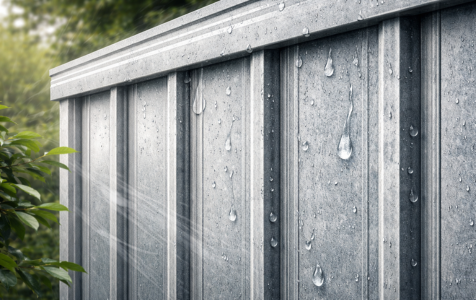
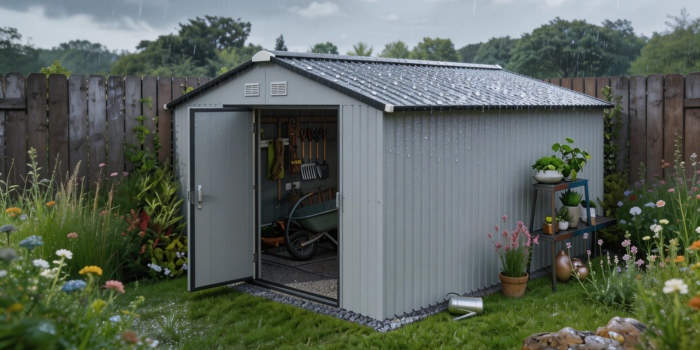
Performance Characteristics: ① Strength derived from the structural system ② Protective method: Coatings (galvanized/painted)
Advantages: ① Impact-resistant ② Long service life
Risks: ① Condensation ② Corrosion after coating damage
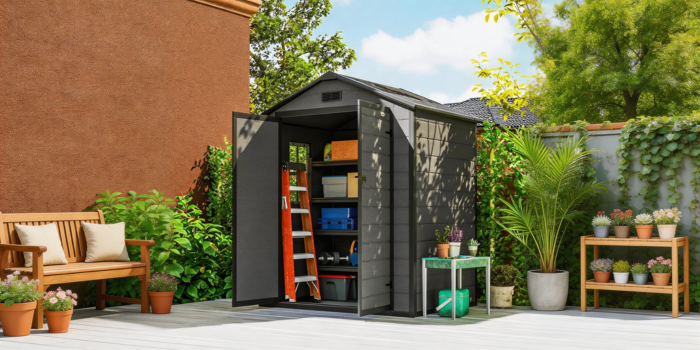
6.2 Plastic Shed
Performance Characteristics: ① Inherent waterproofing ② Structural strength relies on design reinforcements
Advantages: ① No corrosion ② Low maintenance
Limitations: ① Lower stiffness ② Long-term UV degradation

6.3 Wood Shed
Performance Characteristics: ① Natural material ② Dependent on treatment processes
Advantages: ① Aesthetic appeal ② Good insulation properties ③ Easy maintenance
Limitations: ① Moisture absorption
Core Summary
Maintenance | Metal | Plastic | Wood |
|---|---|---|---|
Strength | High (Structure) | Medium | Medium |
Durability | Low | Extremely Low | High |
Lifespan | Long | Medium | Requires Maintenance |
Rust/Decay | Depends on coating | Naturally Resistant | Needs treatment |
7. Application-based Selection Model
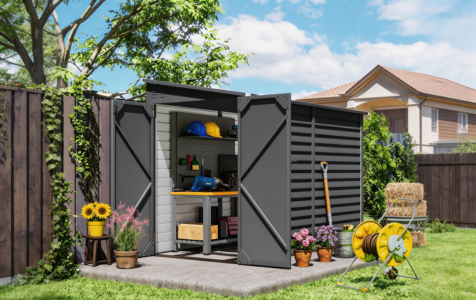
7.1 Metal Shed Ideal Use Cases
- Long-term outdoor use
- Tool storage
Reasoning: Structural stability + Impact resistance
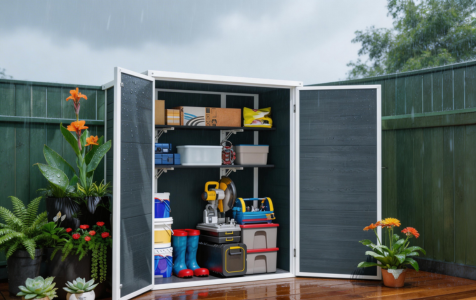
7.2 Plastic Shed Ideal Use Cases
- Humid environments
- Low-maintenance users
- Temporary storage
Reasoning: Waterproof + No need for maintenance
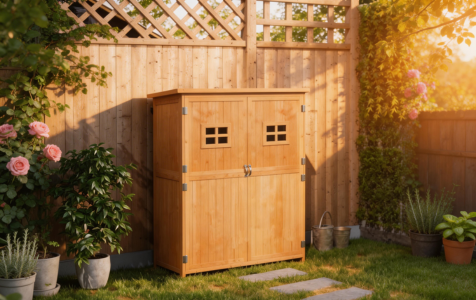
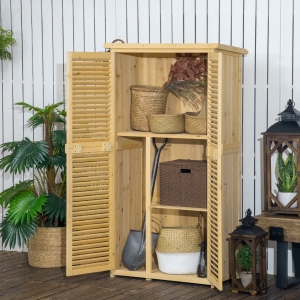
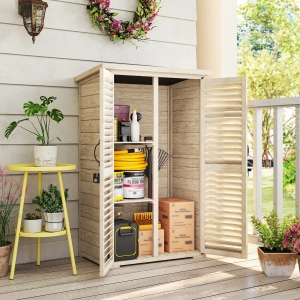
7.3 Wood Shed Ideal Use Cases
- Aesthetic prioritization
- DIY users
Reasoning: Aesthetic appeal + Customizability
Discover the Ideal Shed for Your Space
8. Conclusion
The conclusions of this paper are as follows:
Shed strength derives from the structural system, not the panel thickness.
Thin steel panels are an engineered optimization, not a quality reduction.
Ribbed structures significantly enhance stiffness.
Minor deformation is a normal engineering phenomenon.
The core material differences lie in weather resistance and maintenance costs.
References
National Research Council Canada. (2020).
National Building Code of Canada 2020 (NBCC).
National Research Council of Canada.
https://nrc.canada.ca
Agriculture and Agri-Food Canada (AAFC). (2018).
Greenhouse Engineering and Construction Guidelines for Canadian Growers.
Government of Canada.
https://agriculture.canada.ca
Ontario Ministry of Agriculture, Food and Rural Affairs (OMAFRA). (2017).
Building Sheds and Farm Structures in Ontario.
Government of Ontario.
http://www.omafra.gov.on.ca
British Columbia Ministry of Agriculture. (2015).
Shed and Farm Building Design and Construction.
Government of British Columbia.
CanmetENERGY Research Centre. (2017).
Energy Efficient Shed and Farm Building Materials and Construction Practices.
Natural Resources Canada.
https://canmetenergy.nrcan.gc.ca
Université Laval. (2016).
Thermal and Structural Performance of Shed Materials in Cold Climates.
Laval University, Quebec, Canada.
McGill University – Brace Centre for Water Resources Management. (2014).
Shed Structural Integrity and Wind Resistance in Eastern Canada.
McGill University, Canada.
National Building Code of Canada 2020 (NBCC).
National Research Council of Canada.
https://nrc.canada.ca
Agriculture and Agri-Food Canada (AAFC). (2018).
Greenhouse Engineering and Construction Guidelines for Canadian Growers.
Government of Canada.
https://agriculture.canada.ca
Ontario Ministry of Agriculture, Food and Rural Affairs (OMAFRA). (2017).
Building Sheds and Farm Structures in Ontario.
Government of Ontario.
http://www.omafra.gov.on.ca
British Columbia Ministry of Agriculture. (2015).
Shed and Farm Building Design and Construction.
Government of British Columbia.
CanmetENERGY Research Centre. (2017).
Energy Efficient Shed and Farm Building Materials and Construction Practices.
Natural Resources Canada.
https://canmetenergy.nrcan.gc.ca
Université Laval. (2016).
Thermal and Structural Performance of Shed Materials in Cold Climates.
Laval University, Quebec, Canada.
McGill University – Brace Centre for Water Resources Management. (2014).
Shed Structural Integrity and Wind Resistance in Eastern Canada.
McGill University, Canada.
About the Author
Dr. Nathaniel Brooks
Dr. Nathaniel Brooks is a researcher in agricultural systems engineering, focusing on the design and construction of agricultural structures, especially sheds and greenhouses in cold climates. His work examines the relationship between building materials, structural integrity, and environmental factors, with an emphasis on energy efficiency and durability in Canada’s harsh weather conditions. Dr. Brooks has contributed to studies on thermal performance and material resilience, providing practical solutions to ensure the longevity and sustainability of agricultural buildings.
Dr. Nathaniel Brooks is a researcher in agricultural systems engineering, focusing on the design and construction of agricultural structures, especially sheds and greenhouses in cold climates. His work examines the relationship between building materials, structural integrity, and environmental factors, with an emphasis on energy efficiency and durability in Canada’s harsh weather conditions. Dr. Brooks has contributed to studies on thermal performance and material resilience, providing practical solutions to ensure the longevity and sustainability of agricultural buildings.